About
The Practice is built by a working practitioner. Every idea in it was proven in a real business, where a mistake has consequences, before it was ever taught to anyone else.

Over the past few years, artificial intelligence arrived in serious professional work with a great deal of hype and very little discipline. The most capable professionals were told to "use AI" by people who could not tell them what to do when the tool invents a figure in a document, or what should never be pasted into a chatbot in the first place.
The response was to build systems, slowly and then thoroughly: research that cites its sources, drafting that knows its guardrails, workflows that compound instead of resetting every morning. AI as operating infrastructure rather than a party trick, run with the same discipline a careful professional brings to everything else. The Practice is that discipline, made available.
In the AI era, the professionals who win will not be the ones with the best tools. They will be the ones who run their business like a practice: systematized, sourced, deliberate, compounding.
Tools are rented.
Discipline is owned.
AI is compressing the middle of every business, the coordination, production, and execution work, while judgment and the work that carries real consequence stay human. That compression makes the practitioner's seat more valuable, not less. By 2026 the market said it out loud: the frontier laboratories themselves began building firms whose only product is deployment.
A practice is what a professional builds over a career: a body of work refined by repetition, held to a standard, and worth more the longer it runs. A doctor has a practice. So does a lawyer, an architect, an investor. The word means both things at once, the discipline of practicing a craft and the enterprise that discipline becomes.
That is the whole idea. Run your business like a practice, in any field, and AI stops being a novelty and becomes infrastructure. The same discipline that governs the practice of marketing governs the practice of operations, or of building a company from the ground up. The Practice is the name for that standard, and for the systems that make it repeatable, whatever the domain.
Every image here holds to one scene: a stoa, columns bearing weight, open to the sea in late light. The columns are the infrastructure, the systems a professional stands up so the work can bear weight. The sea is the landscape every practice sits inside, industry and market and the wider world, with the horizon left open on purpose. The water is calm, and the calm is the point: stillness is the building window. Foundations go in while the sea is quiet and the incumbents are unhurried, because nothing structural gets built in a storm. And the light never says whether it is rising or setting, because it is both: the close of professional life as it has been, and the first hours of what it is becoming.

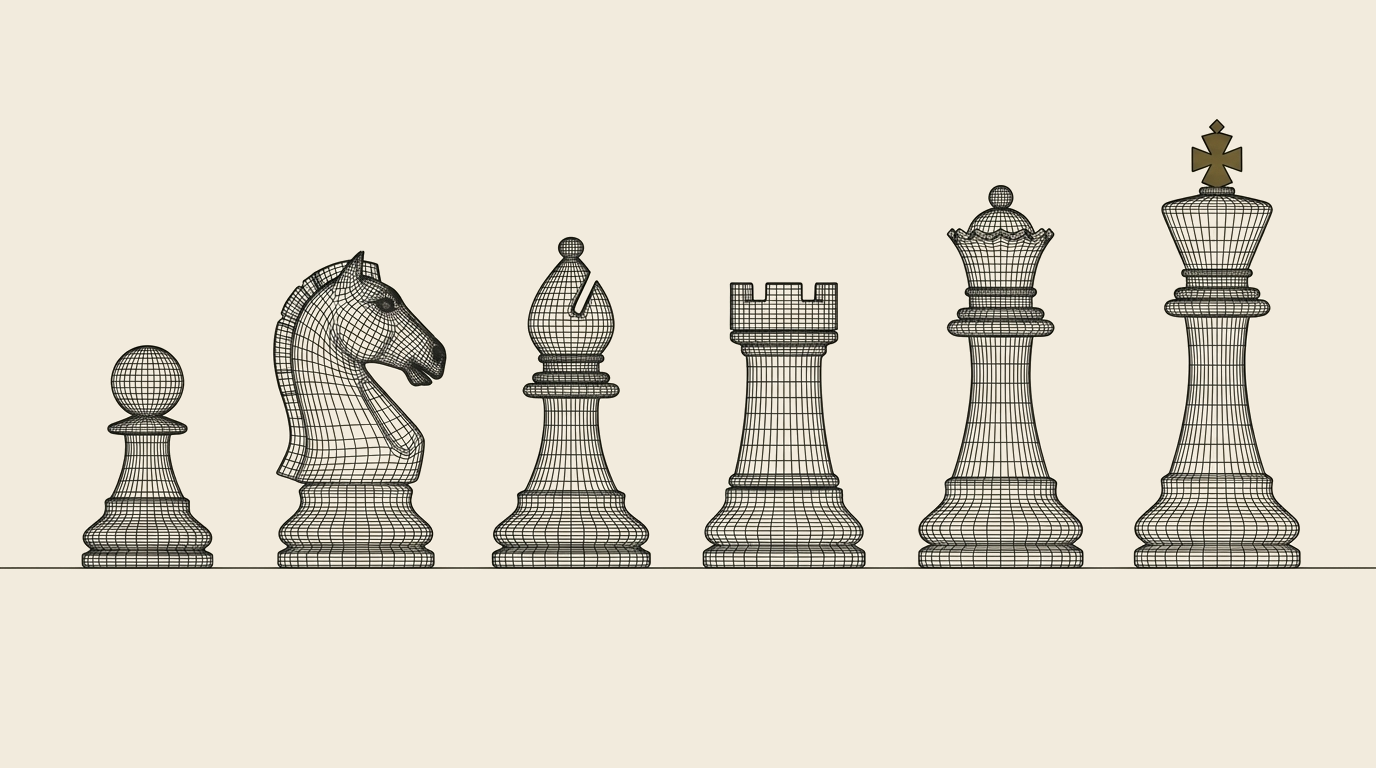
One more object belongs to the scene. Inside the stoa, on the study table, a board. The pieces are the capabilities a practice develops: the pawn that advances one square at a time, the knight that jumps, the bishop that runs one long diagonal, the rook that is itself a building, the queen that moves in every direction at once. The practitioner is none of these.
The practitioner is the king: not the strongest piece on the board, but the one the entire game is about, the one every other piece exists to serve. The sea outside says where a practice stands. The board inside says how it plays. And the two agree on the essential point: you castle while the water is calm.
The Practice is practitioner-built infrastructure. It starts with education, extends into a productized operating system for growth-stage companies and professional teams, and it publishes its thinking in public, twice a month. What you can buy is what was already built and proven, not a theory.
The Practice stands on more than twenty thousand hours of researching, deploying, and managing three disciplines: artificial intelligence, blockchain, and cybersecurity. Behind it sit certifications and course completions from Microsoft, Google, OpenAI, Anthropic, and Amazon, and the Certified Artificial Intelligence Expert and Certified Blockchain & Law Professional designations from a global certifying body whose credentials are trusted at firms like Microsoft, IBM, KPMG, and Ernst & Young. The deeper proof is the working system that this site, the letters, and every engagement run on.
Two commitments govern everything sold under this name. The first is truth-seeking: conclusions follow the evidence, claims carry their sources, and an honest "this will not work for you" outranks a comfortable pitch. The second is that the work must add value rather than extract it. Much of modern business is engineered around a single question, how much can be taken from the customer, and it shows. The Practice is built on the opposite question: what would actually elevate this client and their practice. Teach openly, price plainly, and measure the engagement by the share of the client's work that no longer needs them. When an engagement stops clearing that bar, it ends.
The Practice is published by a Georgia limited liability company; the full legal notice appears in the footer of every page. It is written and built by Jake Griffith, a Georgia real estate closing attorney. The letters are where the thinking is published; the education and infrastructure are how the work sustains itself.
Begin
Request access to the pilot, or read the letters first and see the practice for yourself.